The Largest Connectivity IPO in History

Managing Partner
An S-1 is an audited argument. A company tells you, under penalty of law, what it believes its business is and what could break it. Press releases persuade. Earnings calls perform. The S-1 discloses.
So when the largest IPO in history priced this week, I read the filing instead of the coverage. SpaceX began trading June 12 at $135 per share, a valuation near $1.8 trillion, raising roughly $75 billion. The record books will log it as the biggest offering ever. Most of the coverage calls it an AI story. The company itself leads with a $26.5 trillion AI market following the xAI consolidation.
The filing says something different.
The inversion
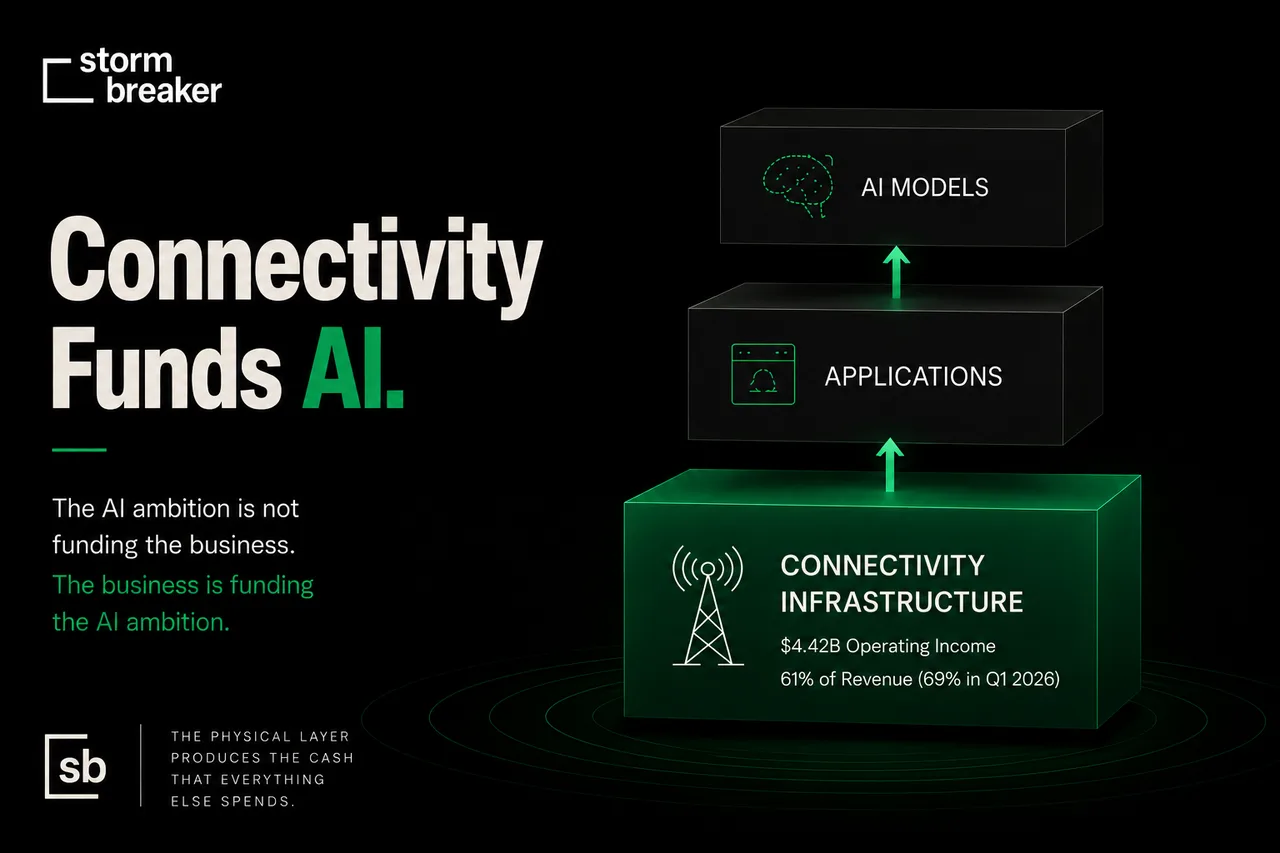
Connectivity generated $11.39 billion in 2025. That is 61% of total revenue, and it rose to 69% in the first quarter of 2026. It was also the only profitable segment. Connectivity earned $4.42 billion in operating income last year. The AI division lost $6.35 billion. Launch lost $657 million.
Read that again. The AI ambition is not funding the business. The business is funding the AI ambition. Bandwidth, spectrum, satellites, and ground infrastructure produce the cash that everything else spends.
The margin trajectory tells you why. Connectivity EBITDA margins went from 41% in 2023 to 63% in 2025. Constellation economics compound: once the network exists, each new subscriber arrives at near-zero marginal cost. That is utility economics with software margins, and it is the engine the market actually priced.
Strip out the narrative and this is not a vote on models. It is the market finally pricing what physical connectivity infrastructure is worth at scale.
The valuation is not pricing rockets. It is pricing the pipe.
Fifteen years of mispricing
For most of the last fifteen years, venture treated infrastructure as the slow, unfashionable corner of tech. Software ate the world and capital followed it up the stack. The physical layer underneath, the networks and spectrum and compute fabric that software runs on, was treated as a utility. Low growth, low multiple, somebody else's problem.
Meanwhile the companies laying the actual rails compounded quietly. SpaceX was private for 24 years before this offering. Overnight successes are years of groundwork that suddenly become visible. This week, the groundwork became visible, and it carried a thirteen-figure price tag.
Public markets have started paying for purpose-built physical infrastructure elsewhere too. CoreWeave trades at a premium to general-purpose cloud because the market is pricing scarcity and specialization in AI compute. SPCX extends that repricing to the connectivity layer. The pattern is the same: the constraint in the AI era is physical, and the market is finally paying for the companies that own the constraint.
This is the thesis Stormbreaker was built on. The investable bottleneck of the AI era sits in the connectivity and compute fabric, not the model layer. For years that was a contrarian position. As of Friday, it is a $1.8 trillion line item.
From thesis slide to audited line item
One disclosure in the filing deserves more attention than it is getting. Direct-to-cell, the convergence of satellite and cellular networks, generated $632 million in 2025 across more than 30 carrier partnerships on six continents. The prospectus describes next-generation direct-to-smartphone service designed to be on par with terrestrial networks, even in urban areas. The EchoStar spectrum acquisition, up to $17 billion in cash and stock, says the company intends to accelerate.
Not long ago, satellite-cellular convergence was a thesis slide. We know, because it was one of ours. It is now disclosed, audited, and priced by public markets.
The framing matters as much as the number. Satellite-to-cell is emerging as a complementary layer, not a replacement. SpaceX does not need to beat the carriers. It needs the carriers to pay for coverage every time a subscriber leaves terrestrial range. That removes the conflict that would otherwise cap the market, and it turns every mobile operator on earth into a potential customer.
The seams
Here is the part that matters most for early-stage investors, and the part the coverage misses entirely.
A $1.8 trillion anchor at the top of the stack does not close a category. It opens one. SpaceX validated the demand curve for converged connectivity at planetary scale. But no company, at any size, owns the seams: the integration layer between satellite and terrestrial networks, AI-RAN, edge compute, and the ground-side infrastructure carriers will need to absorb this shift. Vertical integration creates the anchor. The ecosystem gets built in the gaps around it.
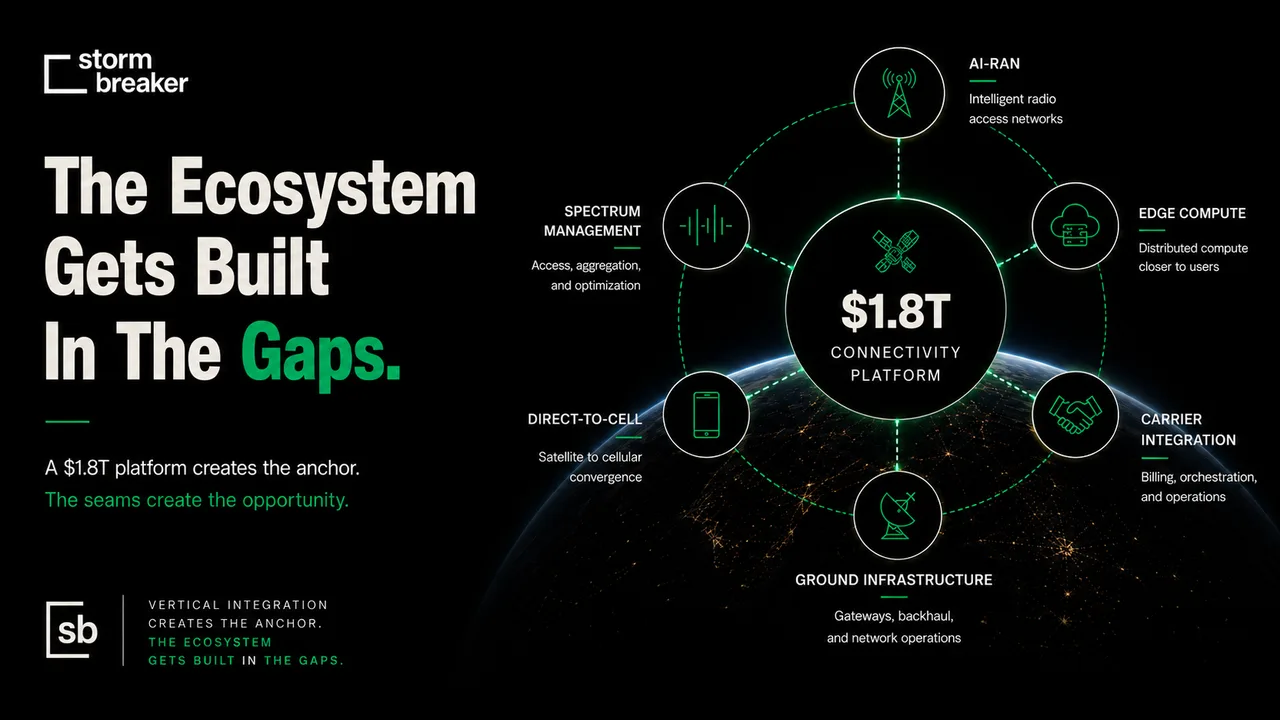
Those seams are where venture-scale companies get built. They are technical, unglamorous, and essential, which is exactly the profile of the companies we back. The IPO is a starting gun for the ecosystem, not a finish line.
That is where we spend our time.
Stormbreaker Ventures invests at the intersection of AI, physical infrastructure, and connectivity. Figures cited are from the SpaceX Form S-1 and public coverage of the offering.
Building in the Connected Ecosystem? We find them early. We help them win.
Get in Touch→Perspectives from the connected ecosystem, in your inbox.
Occasional field notes on AI-native connectivity, edge compute, and the infrastructure layer we invest in. No noise.