
- In telecom, durable value came from owning what could not be replicated - spectrum, footprint, hardware integration - not from product features.
- In AI, the intelligence is commoditizing while the connectivity, edge compute, and spectrum beneath it are not. Defensibility lives in the substrate.
- The companies owning that substrate are raising at seed today, before carrier procurement and strategic valuations catch up. That gap is the return.
The companies with the most durable value in telecom never won on product alone. They owned what could not be replicated: spectrum, network footprint, proprietary hardware integration. Product features came and went. The underlying assets compounded for decades.
Most investors in AI have forgotten that pattern exists.
The prevailing view right now is that AI makes any business defensible. Add a model, gain a moat. In the markets we invest in, the causality runs the other way. Defensibility sits in the connectivity layer, the edge compute footprint, and the spectrum relationships. AI runs on top of what gets built there, not the other way around.
The intelligence is increasingly a commodity. The substrate it runs on is not.
Backing the application layer without owning the infrastructure beneath it is like investing in SaaS in 2005 without asking who owns the data centers. Everyone wanted the applications. AWS made more money than most of them combined, and it did so precisely because the application companies could not function without it. The infrastructure provider captured the economics of an entire category without having to win any single market within it.
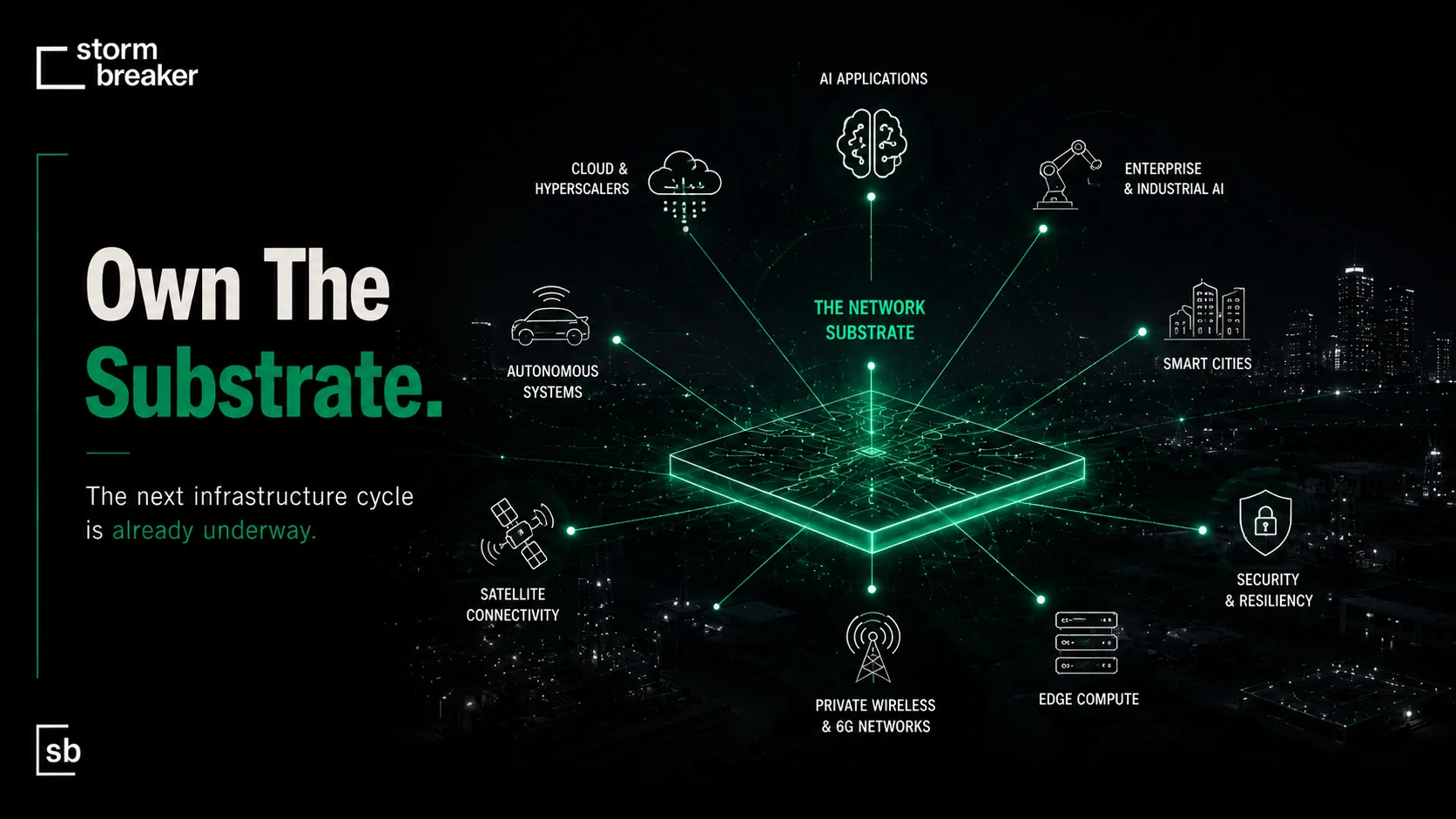
The physical substrate everything above depends on - and where we invest.
Whoever owns the substrate collects from every layer above it.
That pattern is playing out again right now in radio networks, edge compute, private wireless, and satellite-cellular systems. The structural position is identical: thousands of AI applications, all dependent on a physical layer that very few companies are building. Whoever owns that layer collects from all of them.
The timing is what makes this actionable rather than academic. The companies owning the substrate are raising at seed today. The acquirers who will eventually buy them, the carriers, the primes, the hyperscalers, are already signaling intent through partnerships, pilot programs, and corporate venture activity. The gap between seed prices now and strategic value later is the return.
We invest at this layer at pre-seed and seed, deliberately before carrier procurement cycles open and valuations adjust to what the strategics already know. And we built the firm so that the people making those decisions have lived the asset class from the inside. Glenn Lurie ran the biggest wireless business on the planet at AT&T. Wade Oosterman founded Clearnet and sold it to Telus for $6.6 billion. Derek Aberle ran Qualcomm as President.
We did not study this cycle from the outside. We helped build the last one, and the last one is the best guide to where the value settles in this one.
The models will keep improving and the applications will keep multiplying. Both outcomes increase the value of the network underneath them. If you are constructing a portfolio for the next infrastructure cycle, that is the asymmetry worth understanding first.
Building in the Connected Ecosystem? We find them early. We help them win.
Get in Touch→Perspectives from the connected ecosystem, in your inbox.
Occasional field notes on AI-native connectivity, edge compute, and the infrastructure layer we invest in. No noise.